
UMass MedTech · Team project
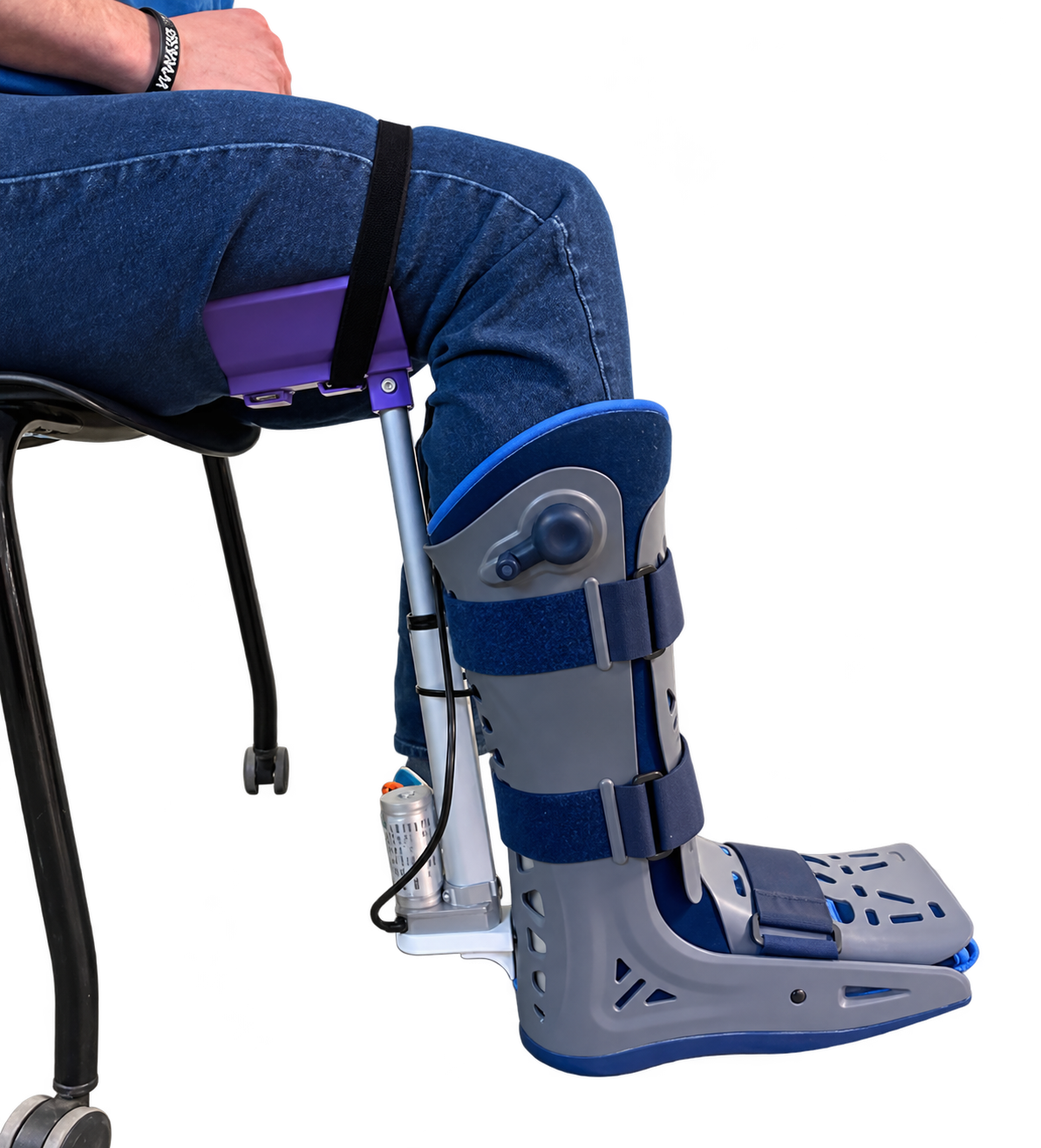
KneeVive traction therapy boot
Developing an adjustable knee-traction mechanism for an at-home therapy concept.
- My work
- Led a 10-person team and designed the mechanical assembly
- Result
- 2nd place at UMass Tech Challenge; $2,500 for development
- Status
- Physical prototypes built and tested
The design challenge
After finding published research on knee traction therapy, I wanted to explore how that work could inform an at-home therapy device. The design goal was a non-invasive traction concept with adjustable, repeatable force.
My contribution
This was the first project I led as vice president of the UMass MedTech Team during my sophomore year. I led a 10-person team through design and prototyping, from the initial concept to a physical prototype, and designed the mechanical assembly.
Prototype development
We fabricated and tested multiple prototypes to evaluate force consistency and comfort while refining portability and manufacturability. The project won 2nd place at the UMass Tech Challenge and earned $2,500 for further development.
Engineering takeaways
Treat the body interface as part of the mechanism
The traction assembly acts through the boot and its attachment to the user. Fit and support belong in the load path alongside the force-generating mechanism.
Evaluate force consistency and comfort separately
The team fabricated and tested multiple prototypes while refining portability and manufacturability. An adjustable mechanism still needs repeatable force delivery, and mechanical performance alone does not establish comfort.
Use the prototype to define the next validation step
The project won second place at the UMass Tech Challenge and earned $2,500 for further development. The next mechanical evaluation should test whether a given setting delivers comparable force after removal and refitting.